Today, cricket is a global phenomenon, captivating billions with its explosive T20 leagues, dramatic Test matches, and the passion of international rivalries. The sound of leather on willow echoes in massive stadiums from Mumbai to Melbourne. But this sophisticated modern sport has surprisingly humble and murky origins, rooted in the rolling hills of rural England centuries ago.
This post will journey back in time to uncover the origins of cricket. We will explore how a simple pastime played by shepherds evolved into a structured sport, how its early rules were formed, and how the British Empire carried it across the oceans to become the beloved game it is today. Let’s look at the fascinating story of how cricket began.
A Shepherd’s Diversion: The Earliest Days
The exact origin of cricket is lost to history, but it is widely believed to have begun as a children’s game in the Weald, a dense area of woodland and clearings in southeast England, during the Saxon or Norman times. The earliest forms of the game were likely played by farming and shepherding communities.
The tools of the trade were simple. Shepherds would use their crooks—the curved staffs used for herding sheep—as bats. The “wicket” was likely the gate of a sheep pen, and the “ball” would have been a small, compressed clump of wool, stone, or wood. The object was simple: a “bowler” would try to hit the wicket gate while a “batsman” defended it with their crook. The low, two-stump wicket of early cricket is thought to have originated from the style of these gates.
The name “cricket” itself has several possible origins. It may derive from the Anglo-Saxon word “cricc,” meaning a shepherd’s staff. Another theory suggests it comes from the Flemish word “krick,” meaning a stick. This connection stems from the close trade links between southeast England and Flanders during the 15th century. Whatever its exact source, the name became associated with this simple country game.
From Pastime to Organized Sport
For centuries, cricket remained a local, unorganized folk game. The first confirmed reference to cricket being played by adults dates back to 1611, when two men in Sussex were prosecuted for playing cricket on a Sunday instead of going to church. This tells us two things: the game had become popular enough among adults to warrant legal action, and it was considered a distraction from more pious duties.
Throughout the 17th century, the game started to gain traction, especially in the southeast of England. The English Civil War briefly interrupted its growth, but it returned with renewed vigor after the Restoration in 1660. The “Merry Monarch,” King Charles II, brought a new vibrancy to English social life, and sports like cricket began to thrive.
The late 17th century also saw the first instances of cricket being played for money. Wealthy patrons began to form their own “teams” and wager on the outcomes of matches. This introduction of gambling was a crucial step in cricket’s development. It led to the creation of the first professional players and demanded a more standardized set of rules to ensure fair play.
The First Rules and the Hambledon Club
The 18th century was the period when cricket truly began to take shape as an organized sport. The earliest known written “Articles of Agreement” for a cricket match date back to 1727. However, the first formal “Laws of Cricket” were drawn up in 1744. These laws established fundamental principles, such as the 22-yard pitch, the dimensions of the stumps, and the methods of getting a batsman out.
The epicenter of cricket’s development during this period was a small village in Hampshire called Hambledon. The Hambledon Club, which flourished from the 1760s to the 1780s, was the most important cricket club of its time. It was a combination of a social club and a professional team, backed by wealthy patrons.
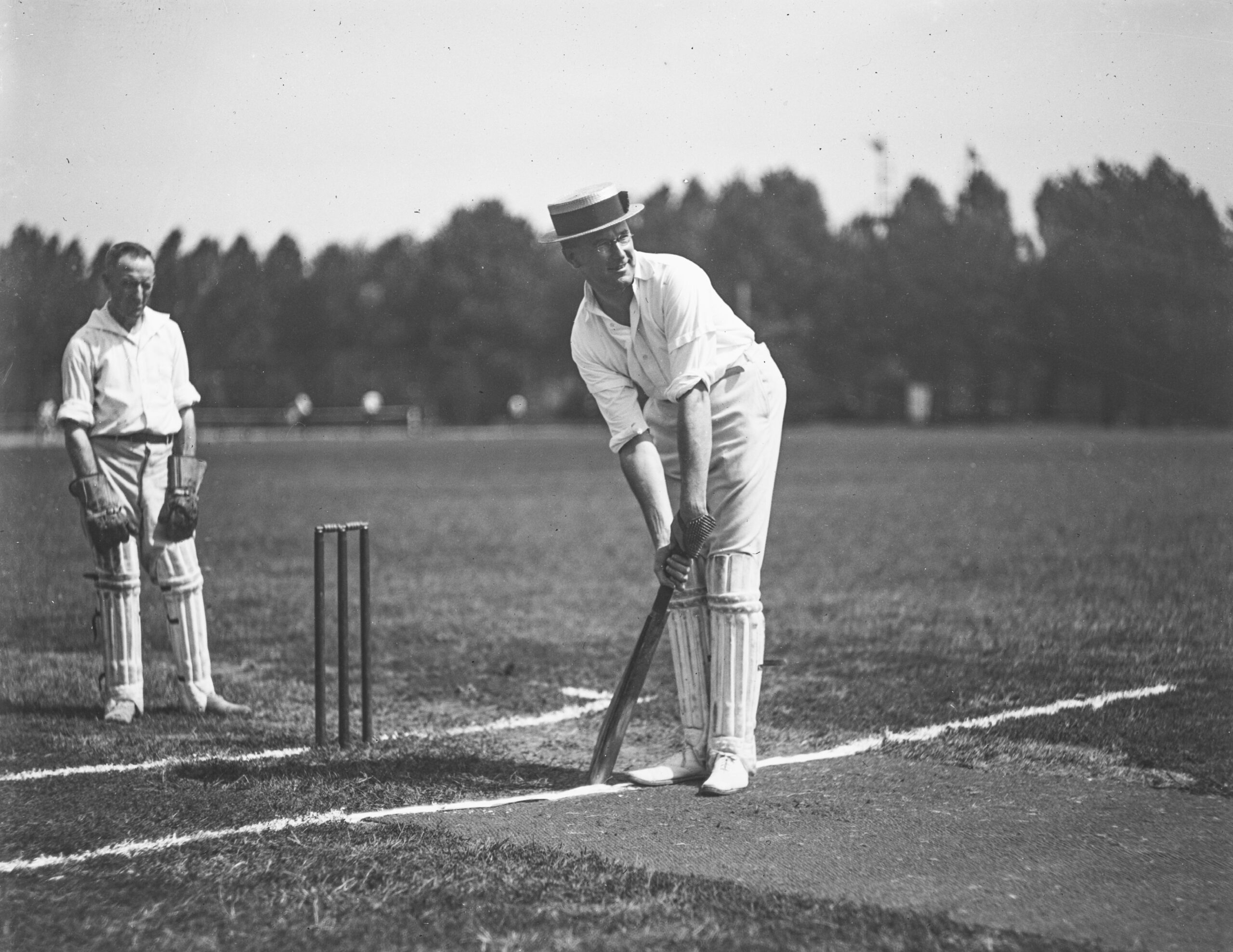
Hambledon was the “cradle of cricket,” where the game was refined and innovated. Players at Hambledon were responsible for key technical developments. The straight bat, for example, replaced the curved, hockey-stick-like bat of early cricket. This change was a response to the evolution of bowling. Bowlers had started to “pitch” the ball, moving away from the underarm roll that was common before. A straight bat was far more effective for playing these bouncing deliveries.
The Marylebone Cricket Club (MCC) and the Lord’s Ground
As cricket’s popularity grew, the center of influence shifted from rural Hambledon to London. In 1787, the Marylebone Cricket Club (MCC) was founded. The MCC quickly established itself as the game’s premier club and its official lawmaker.
A year after its formation, the MCC acquired a new ground in London, established by an ambitious entrepreneur named Thomas Lord. This became the first “Lord’s Cricket Ground.” Lord’s became the new home of cricket, and the MCC took on the responsibility of codifying and revising the game’s laws. The MCC’s 1788 revision of the laws established the foundation of the rules that still govern the game today, including the introduction of the Leg Before Wicket (LBW) rule.
The MCC’s authority gave cricket a central governing body, which was essential for its continued growth and standardization. For over 200 years, the MCC remained the sole authority on the Laws of Cricket, a role it only handed over to the newly formed International Cricket Council (ICC) in recent times.
Cricket Travels the Globe: The British Empire’s Sport
Cricket’s expansion beyond the shores of England is directly linked to the growth of the British Empire. As British sailors, soldiers, and colonial administrators traveled the world, they took their favorite sport with them. Cricket became a way for expatriates to maintain a connection to home and a symbol of British culture.
The game first took root in North America in the 18th century, though its popularity there was eventually eclipsed by baseball. The first official international cricket match was actually played between the USA and Canada in 1844.
However, cricket truly flourished in the colonies of the West Indies, the Indian subcontinent, and Australia. In India, the game was introduced by British merchants in the 18th century, and the first club, the Calcutta Cricket Club, was founded in 1792. In Australia, the first recorded match took place in Sydney in 1803. In the West Indies, the game was introduced by soldiers, and it quickly became popular among the local population.
These regions adopted cricket and made it their own, infusing it with their unique cultural styles. The sport became a vehicle for national identity, especially as these colonies moved towards independence.
Conclusion: A Game Woven into History
The story of cricket’s origins is a journey from a simple shepherd’s game to a globally recognized sport. It evolved from an informal country pastime into a structured game through the influence of gambling, the patronage of the aristocracy, and the formation of powerful clubs like Hambledon and the MCC. Each step—the invention of the straight bat, the writing of the first laws, and the establishment of Lord’s—was a crucial milestone in its development.
Finally, carried by the currents of empire, cricket spread across the world, where it was embraced and transformed by different cultures. The game we watch today is a product of this long and fascinating history, a sport that is deeply woven into the social and cultural fabric of nations around the globe.