Cricket is a game of glorious uncertainties. While every match has the potential for drama, a select few transcend the sport itself. They are epic sagas of courage, collapse, and comeback that become etched in the memory of every fan who witnessed them. These are the matches that define eras, create legends, and remind us why we love the game.
This post will take a nostalgic journey back to some of the most unforgettable matches in cricket history. We will relive the underdog triumph of the 1983 World Cup final, the relentless drama of the 2005 Ashes series, and the scarcely believable finale of the 2019 World Cup. Get ready to feel the tension and euphoria of the moments that shaped the sport forever.
1983 World Cup Final: The Upset That Changed a Nation
The final of the 1983 Cricket World Cup at Lord’s was meant to be a coronation. On one side was the mighty West Indies, the two-time defending champions. Led by Clive Lloyd, their team was a terrifying force of nature, featuring a battery of ferocious fast bowlers and the devastating batting of Viv Richards. On the other side was India, a team of rank underdogs who had won only a single match in the previous two World Cups combined. No one gave them a chance.
The Match: A Tale of Two Innings
India batted first and the West Indian pace quartet of Andy Roberts, Joel Garner, Michael Holding, and Malcolm Marshall quickly asserted their dominance. The Indian batting lineup crumbled, and they were bowled out for a paltry 183. It seemed like a formality. The mood in the Indian dressing room was somber, but their charismatic captain, Kapil Dev, refused to give up hope. He told his team, “We have a small total to defend, but let’s go out and fight for it.”
The West Indies began their chase with characteristic swagger. The legendary Viv Richards looked in imperious form, racing to 33 off just 28 balls. The game was slipping away fast. Then came the moment that turned the match on its head. Richards miscued a pull shot off Madan Lal, sending the ball high into the air over the mid-wicket region. Kapil Dev, stationed at mid-on, turned and sprinted back, his eyes fixed on the ball. He covered an incredible amount of ground to take a spectacular, running catch over his shoulder.
The Impact: The Dawn of a New Era
The dismissal of Richards sent a shockwave through the West Indian lineup. They panicked and collapsed under the pressure of disciplined Indian bowling. The underdogs had achieved the impossible, winning by 43 runs. The image of Kapil Dev lifting the World Cup trophy on the Lord’s balcony is one of the most iconic in cricket history.
This victory transformed the sport in India. It ignited a passion for cricket that turned it from a popular sport into a national obsession. It inspired a generation of future superstars, including a young Sachin Tendulkar, who has said that watching India win in 1983 was the moment he dreamed of playing for his country. The 1983 final was more than just an upset; it was the birth of modern Indian cricket.
The 2005 Ashes: “The Greatest Series Ever Played”
The Ashes rivalry between England and Australia is the oldest in cricket, but by 2005, it had become painfully one-sided. Australia had dominated for 16 years, winning eight consecutive series with a team of legends that included Shane Warne, Glenn McGrath, and Ricky Ponting. When Australia comfortably won the first Test of the 2005 series at Lord’s, it looked like business as usual. What followed was a summer of cricket so dramatic and relentlessly thrilling that it is widely considered the greatest series ever played.
The Edgbaston Test: A Two-Run Thriller
The turning point came in the second Test at Edgbaston. England, inspired by the aggressive captaincy of Michael Vaughan and the all-round brilliance of Andrew “Freddie” Flintoff, fought back hard. They set Australia a target of 282 to win. The chase came down to the wire. Australia’s last pair of batsmen, Brett Lee and Michael Kasprowicz, edged their team to within three runs of victory.
Then, England paceman Steve Harmison bowled a bouncer that Kasprowicz gloved behind to the wicketkeeper. England had won by just two runs, the narrowest margin in Ashes history. The enduring image of the match was not of celebration, but of sportsmanship: Flintoff consoling a distraught Brett Lee on the pitch. This moment set the tone for a series that was fiercely contested but played in the right spirit.
The Impact: Revitalizing Test Cricket
The rest of the series was a rollercoaster of emotion. There were heroic centuries, devastating spells of bowling, and a nail-biting draw at Old Trafford. England finally clinched the series 2-1 at The Oval, reclaiming the Ashes for the first time since 1987.
The 2005 Ashes captured the imagination of the entire nation. It was front-page news every day and brought Test cricket back into the mainstream in a way not seen for decades. It reminded everyone of the unique drama and narrative power of the five-day game, proving that Test cricket could be just as exciting as its shorter-format cousins.
2019 World Cup Final: The Unbelievable Finale
If you were to write a script for the most dramatic cricket match possible, it would probably be dismissed as too unrealistic. Yet, the final of the 2019 Cricket World Cup between England and New Zealand at Lord’s delivered a level of drama that defied belief. It was a game of unbelievable twists, improbable luck, and a conclusion that left the entire cricketing world breathless.
The Match: Tied Twice
England, playing in their home World Cup, were chasing 242 to win their first-ever title. The chase was a struggle, and they needed 15 runs from the final over, with Ben Stokes on strike. The first two balls were dots. The third was dispatched for a six. The fourth ball produced the most bizarre moment in World Cup history. Stokes, desperately diving to complete a second run, accidentally deflected the throw from the deep with his outstretched bat, and the ball ran away to the boundary for four overthrow runs. In total, England got six runs from the ball.
The equation came down to two runs needed from the final ball. Stokes could only manage a single, and his partner was run out. The match was a tie. For the first time in World Cup history, the final would be decided by a “Super Over”—a one-over-per-side eliminator.
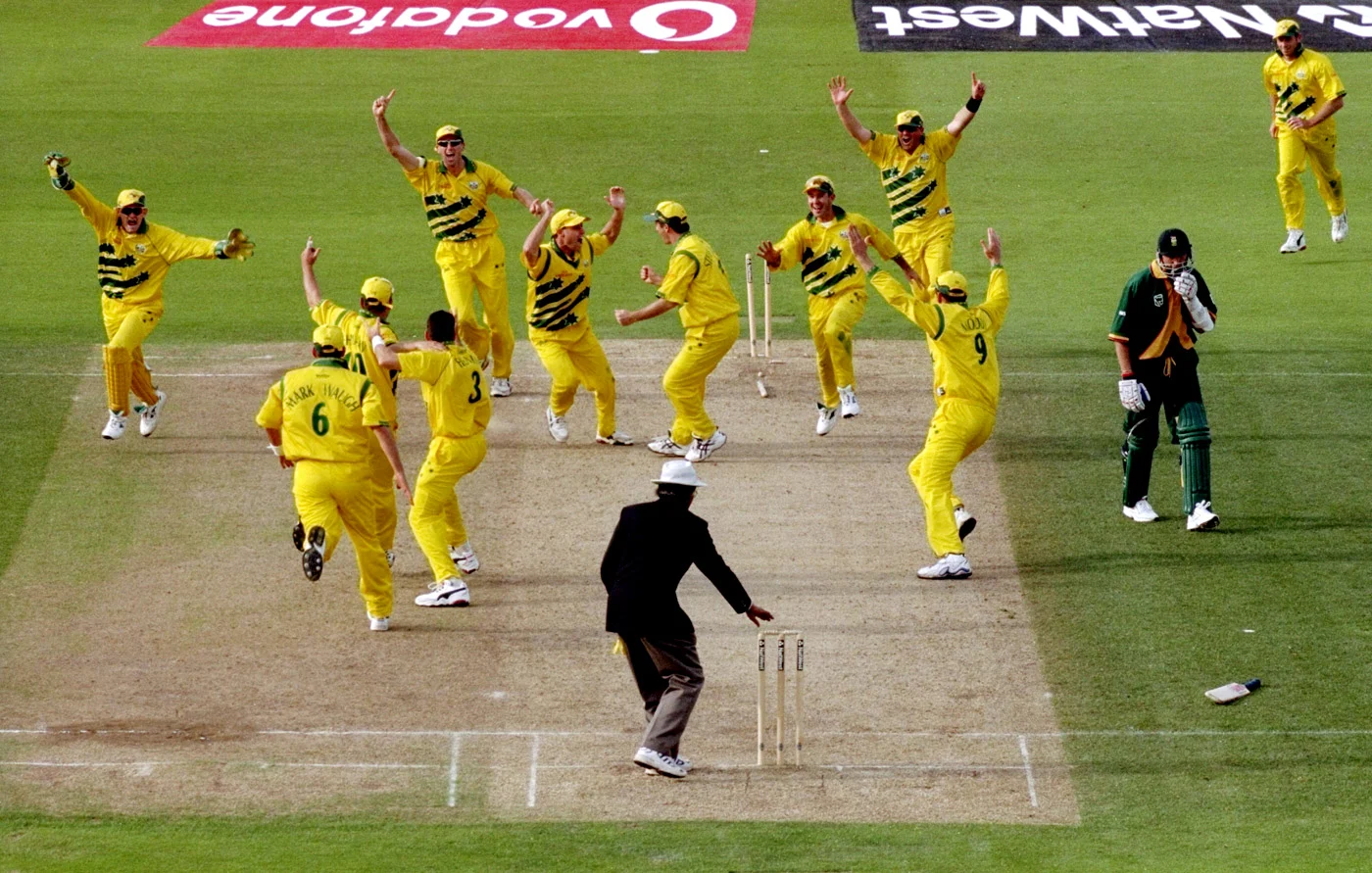
Stokes and Jos Buttler scored 15 runs for England. New Zealand needed 16 to win. Incredibly, they also scored 15. The Super Over was also a tie. The winner was decided on a controversial tiebreaker rule: England were crowned champions because they had hit more boundaries during their 50-over innings.
The Impact: A Game of Inches
The 2019 final was a brutal and exhilarating illustration of the fine margins that decide sporting contests. The image of New Zealand’s Martin Guptill being run out on the final ball, securing England’s victory by the barest of margins, is unforgettable. While England celebrated a historic triumph, there was widespread sympathy for New Zealand, who lost the World Cup without being beaten in the final. The “boundary countback” rule was heavily criticized and later scrapped.
This match will be remembered as the most dramatic final in cricket history. It was a game that had everything: heroic performances, unimaginable luck, and a conclusion that was both thrilling and heartbreaking in equal measure.